

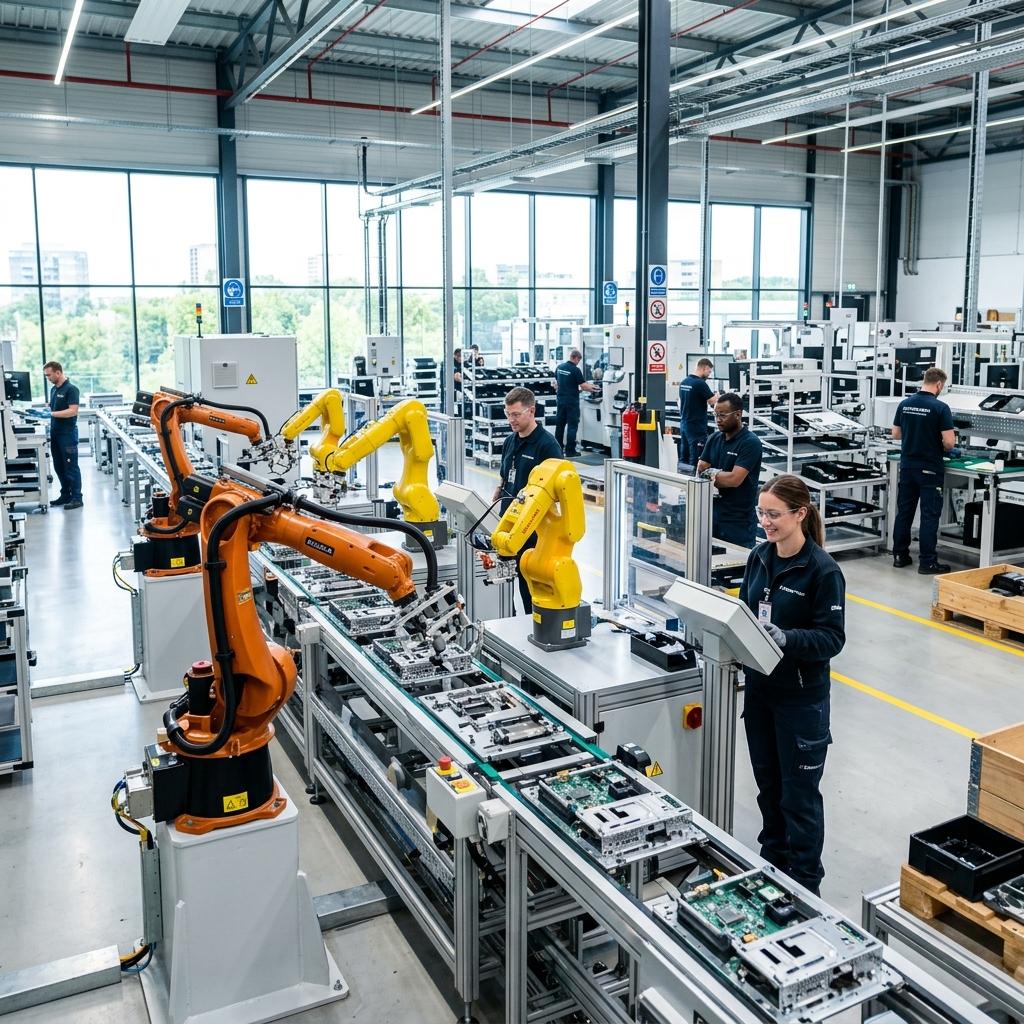
Manufacturing Inspection and Quality Software for the Factory Floor
IndeForms replaces the clipboards, shift registers and spreadsheet trackers that sit between your production lines and your ERP. Supervisors and quality engineers build inspection, audit and log forms without writing code; operators complete them on Android and iOS devices that keep working when plant Wi-Fi does not; and every record lands in one auditable store the moment a device reconnects. What you get back is a single queryable version of what actually happened on each shift, on each machine, at each station.
What paper costs a plant
A typical plant runs on paper long after the rest of the business has gone digital. Shift handover happens in a hardbound register that exists in exactly one place. Line clearance, first-article and in-process checks are printed forms a quality engineer files in a cabinet. Preventive-maintenance checklists hang on a clipboard next to the asset. Near-miss slips go into a box by the gate. None of it is searchable, and none of it reaches a dashboard without somebody re-typing it.
The cost shows up in three places. First, latency: a defect trend that is present in the data on Monday only becomes visible to a human in the monthly quality review, so containment starts weeks late and the scrap is already boxed. Second, rework: quality and EHS teams spend a large share of every week transcribing forms into spreadsheets and then reconciling those spreadsheets against the ERP, instead of investigating what the forms actually said. Third, evidence: when a customer auditor asks for twelve months of torque-check records for one machine, the answer is a physical search through binders, and a gap in that search is indistinguishable from a check that was never performed.
Paper also quietly caps what you are allowed to ask for. Every extra field on a printed checklist is another line somebody has to key in later, so forms get shortened, photographs never get attached, and the operator who actually found the problem is never the person who ends up describing it.
The standards these records have to survive
Manufacturing records are rarely just internal paperwork. They are the evidence base for certification audits, customer audits and statutory inspections, and the way they are captured decides whether they hold up. These are the regimes plants most often build IndeForms against.
ISO 9001:2015
International Organization for Standardization
What it requires
Clause 7.5 requires documented information to be identified, version controlled, legible and retained. Clause 8.5.1 requires evidence that production ran under controlled conditions, including monitoring and measurement at defined stages.
How IndeForms supports it
Published form versions are immutable and restorable, each submission records the form version it was captured against, and answers can carry a per-field timestamp so a monitoring record cannot quietly be back-dated.
ISO 45001:2018
International Organization for Standardization
What it requires
Hazard identification, worker consultation, incident investigation, and retained documented evidence that the operational controls the organisation claims are actually being applied.
How IndeForms supports it
Near-miss and incident forms with photo, geolocation and severity classification, multi-step approval chains that route an investigation to the safety officer and plant head, and an export of every action taken with who took it and when.
ISO 14001:2015
International Organization for Standardization
What it requires
Monitoring and measurement of operations with significant environmental aspects, retained results, and a periodic evaluation of compliance obligations.
How IndeForms supports it
Scheduled dispatch pushes effluent, stack, noise and waste-log rounds to the responsible operator on a cron schedule in the plant timezone. Exception rules colour an out-of-range reading the moment it is entered, and escalation happens inside the shift rather than at month end.
Factories Act, 1948 and the state Factories Rules
State factory inspectorates, India
What it requires
Occupiers must maintain registers of accidents and dangerous occurrences, records of examination of hoists, lifting tackle and pressure vessels, and monitoring records for hazardous processes, and produce them on demand to the Inspector of Factories.
How IndeForms supports it
Each statutory register becomes a form with fixed field definitions, mandatory questions and a named approver, so the register is complete by construction rather than by diligence. Scheduled reports mail the current register to the occupier and the safety officer on a fixed cadence.
IATF 16949:2016
International Automotive Task Force
What it requires
Layered process audits, control-plan conformance, verification of error-proofing devices, and records traceable to part, batch and process identity.
How IndeForms supports it
A barcode-scanner question binds every check to the part, batch and machine without typing. Repeatable sections capture N samples inside one submission, and calculation and aggregation fields compute the sample statistics inline so the operator sees a failing result before they walk away from the station.
29 CFR Parts 1910 and 1904
Occupational Safety and Health Administration, United States
What it requires
General-industry standards including the control of hazardous energy (1910.147) and machine guarding (1910.212), plus the injury and illness recordkeeping duties in Part 1904.
How IndeForms supports it
Energy-isolation checklists with a signature or password e-signature per isolation point, and incident forms whose approved output carries the reviewer name against the recordable decision.
IndeForms supplies the capture, approval, retention and audit-trail controls these regimes ask for. It is a platform, not a certificate: the certification belongs to your organisation and your auditor. We are happy to walk your auditor through exactly how each control is implemented, including on an air-gapped, on-premise deployment.
How manufacturing workflows run on IndeForms
Each of these is a real configuration of the platform — dispatch, offline capture, approval and reporting — not a roadmap item.
Shift handover, captured once and actually read
Handover is the highest-traffic record in most plants and the one most likely to still be a single paper book. Moving it to IndeForms makes it readable off the floor without asking the outgoing supervisor to change how they work.
Dispatch
A scheduled dispatch fires on a cron schedule in the plant timezone and creates one handover form per line, pre-filled with line, shift and asset identifiers from the dispatch payload, then pushes it to the on-duty supervisor.
Field capture
The supervisor completes it on a tablet at the line: machine state, output against plan, open deviations, tooling changes and safety observations. A repeatable section takes one row per stopped machine with reason code, duration and a photograph, and an aggregation field totals downtime as rows are added. The device works entirely offline; nothing is lost when Wi-Fi drops at the far end of the shed.
Approval
On submit, a wait-for-approval node routes the handover to the incoming supervisor. Accepting is an explicit e-signed acknowledgement that the open issues were read. Sending it back returns it to the outgoing supervisor with a comment and a rework counter, so nothing disappears into a verbal conversation.
Report
The accepted handover is emailed as a PDF to the plant head and its downtime rows land in the analytics store, where reason-code Pareto by line and shift is a query rather than a monthly spreadsheet exercise.
Outcome: Handover stops being a book in one room and becomes a searchable, acknowledged record with a named owner on both sides of the shift boundary.
Layered process audit with photographic evidence
Layered process audits only work if the layer above actually walks the floor and the findings are visible. The failure mode is not the audit, it is the twelve days between the audit and anyone reading it.
Dispatch
Audit forms are dispatched to a group rather than an individual, using broadcast assignment so the first available team leader claims the audit and the rest are released. Frequency is driven by the schedule, not by whoever remembers.
Field capture
The auditor scans the station barcode, which binds the record to the process. Rules hide the questions that do not apply to that process family, so a twelve-page master audit renders as the eleven questions that are relevant. A failed answer immediately makes the photo and root-cause fields mandatory, and the camera capture carries a timestamp and location.
Approval
Any non-conformance opens a corrective-action task routed to the process owner. A timer node escalates to the next level if it is not actioned within the agreed window, and the closure step requires evidence before it can be signed.
Report
Completion rate by layer, repeat findings by station, and average closure time are read directly off the submission data, so the audit programme can be managed on facts instead of on a compliance calendar.
Outcome: The audit programme becomes measurable: you can show which layers are actually auditing, which stations keep failing, and how long closure really takes.
Preventive maintenance rounds tied to the asset
PM checklists fail in a predictable way: the round gets signed off in the office, and the reading that would have predicted the failure was never taken. Binding the form to the asset and the location makes that harder.
Dispatch
A scheduled dispatch generates the week of PM rounds from an uploaded asset list, mapping spreadsheet columns onto form fields so each technician receives a round already populated with asset ID, criticality and last service date.
Field capture
The technician scans the asset tag, works through the checklist and enters readings. Validation ranges and exception rules flag a vibration or temperature reading that is out of band while the technician is still standing at the machine. Parts consumed go into a repeatable section with quantity and part number, and a geo-control question records where the round was actually completed.
Approval
Rounds with a flagged reading route to the maintenance planner for review; clean rounds close without a queue. The planner can send a round back for correction, and the loop is bounded so a record cannot bounce indefinitely.
Report
Parts consumption pushes to the ERP through a structured connector, and completion and exception rates by asset and technician feed the reliability review.
Outcome: You can prove the round happened at the asset, and the readings that predict failure are in a column you can trend rather than in a binder.
Near-miss to closed corrective action
Near-miss reporting rises when reporting takes under a minute and falls the moment it needs a form from the safety office. The whole design goal is a thirty-second submission with a real workflow behind it.
Capture
Any worker pulls the near-miss form themselves rather than waiting to be dispatched one. Three questions and a photograph are mandatory; everything else is optional. Voice input fills the description field for operators who would rather speak than type on a phone.
Triage
Severity and category drive the routing. Conditional branches send a high-severity report straight to the plant safety head while a housekeeping observation goes to the area supervisor, and a set-variable node carries the incident reference through every downstream step.
Investigation and approval
Investigation is a second form spawned from the first, pre-bound to the original submission, so the investigation and the report are one linked record. Closure needs an e-signature from the safety officer, enforced on the server rather than in the app.
Report
Open actions, ageing and repeat locations render on the dashboard, and a scheduled report mails the open-action list to the leadership team every Monday morning without anyone assembling it.
Outcome: Reporting effort drops to seconds while the evidence trail behind each report gets stronger, which is the only combination that raises reporting rates honestly.
Which capability solves which problem
The platform features behind the workflows above, mapped onto the constraints this industry actually works under.
Plant Wi-Fi does not reach the far bays or the basement
Offline-first mobile capture
Forms, reference data and compiled rules are downloaded to the device up front. Submissions queue locally, including photos and audio, and sync when the device reconnects, so a dead zone never costs a record.
Every line, customer and auditor wants a different checklist
No-code form builder with 28 question types
Quality engineers assemble forms from textboxes, dropdowns, barcode scanners, camera, sketch pad, signature pad, sliders, calculation and aggregation fields without a developer and without an app-store release.
Operators skip fields they believe do not apply
Rules engine
IF/THEN/ELSE logic shows, hides, requires, clears or sets fields as answers arrive, and can target whole pages and sections. Operators see only the questions that apply, and cannot submit past a mandatory one.
A finding needs three signatures before anyone will call it closed
Workflow engine with enforced e-signature
Wait-for-approval nodes route by user, role, the submitter’s manager, or a value read out of the form itself. Approval can require a password or a drawn signature, verified server-side with a single-use token recorded against the task.
Shop-floor data has to reach the ERP, not a shared drive
Connectors and the API question type
Submissions push out as PDF, email, SFTP file or API webhook, and structured connectors map fields into SAP S/4HANA or Dynamics 365. The API question type pulls master data into the form while the operator is still filling it in.
Nobody can answer which machine actually fails most
Columnar analytics over your own submission data
Submissions are transformed into Parquet and queried in-process with DuckDB, so field-level trends, completion rates and reason-code distributions are available as dashboards, as scheduled reports, or as a plain-English question.
Use cases we support out of the box
Common forms and processes manufacturing teams build first.
Shift Handover Logs
Capture machine state, pending issues, and operator notes at every shift change. Auto-aggregate into supervisor dashboards.
Safety & Compliance Audits
Standardize EHS walkthroughs, near-miss reporting, and regulatory checklists with photo, GPS, and signature evidence.
Quality Control & QA/QC
Inline defect capture, SPC sampling forms, and reject categorization tied directly to batch and machine identifiers.
Preventive Maintenance
Asset-linked inspection checklists with scheduled triggers, escalation rules, and parts-replacement tracking.
Production Reporting
Daily yield, downtime, and OEE inputs collected at source, eliminating spreadsheet reconciliation across plants.
We were not trying to remove paper for its own sake. We wanted the plant head to be able to see on Tuesday what the second shift found on Monday night, without asking anyone to re-type it.
Quality lead, automotive component manufacturing
Representative of conversations with teams in this sector, not a named customer reference.Manufacturing FAQs
The questions buyers in this industry ask before they shortlist a platform.
Can inspection results be pushed into our ERP instead of staying in another system?
Yes. Completed submissions can be routed to an API webhook, an SFTP drop, an email PDF, or a structured connector that maps individual form fields onto target fields in SAP S/4HANA or Dynamics 365. Field mapping is configured per destination on the workflow node, so different forms can feed different modules. Connector credentials are encrypted at rest and outbound calls pass through a server-side egress allowlist.
Can this run inside our own network, without any cloud dependency?
Yes. IndeForms deploys on-premise, and it supports fully air-gapped installations for plants that cannot allow outbound connectivity. In that mode the vendor never runs code inside your install and configuration updates are applied through signed offline bundles rather than a live connection.
How do we make sure a check is recorded against the right machine or batch?
Use a barcode-scanner question to read the asset or batch tag, which removes the transcription error entirely. You can additionally enable per-field geostamping and timestamping at dispatch, so each answer carries where and when it was entered, and use a geo-proximity rule to warn when a check is being completed away from the asset location.
We already have hundreds of controlled paper forms. Do we rebuild them all by hand?
No. You can photograph or scan an existing paper form and have the platform extract its fields and propose matching question types as a draft form, then adjust it in the builder. You can also clone an existing digital form within or across forms, and restore an earlier published version if a change needs to be rolled back.
What does the audit trail actually contain?
Each submission is tied to the published form version it was captured against, the user who submitted it, and the workflow tasks that acted on it, including approvals, rejections, send-backs and comments. Approval e-signatures are verified server-side and recorded against the task. Where per-field metadata is enabled at dispatch, individual answers also carry their own timestamp and geostamp.
Ready to digitize your plant’s field records?
Bring one paper process — a handover register, a layered audit, a PM round — and we will show you what it looks like as a dispatched, rule-driven, approved and reportable record, including how it deploys inside your own network.