

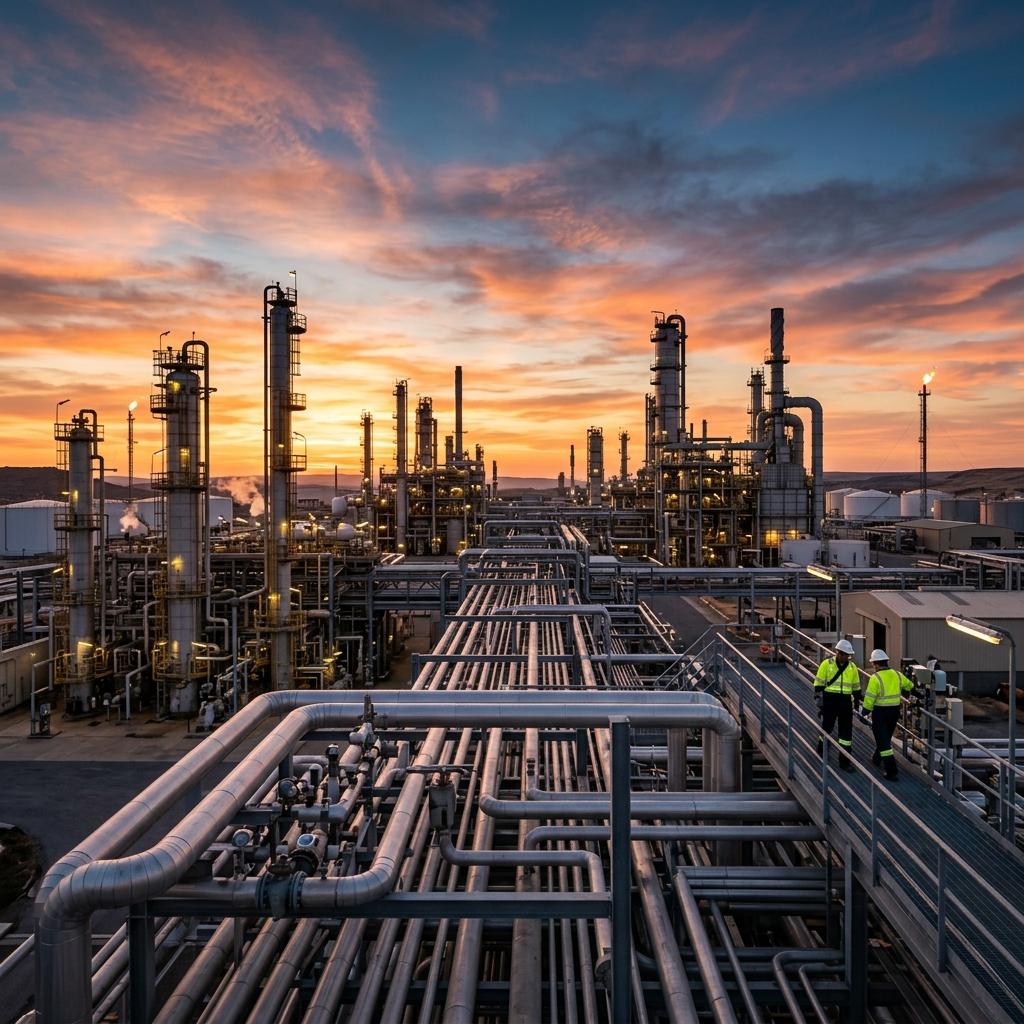
Oil and Gas Inspection Software That Works Offline at the Wellsite
IndeForms is built for crews who work where the network is not. Permit-to-work, integrity inspection, HSE and environmental records are captured on a phone or rugged tablet with no connectivity assumption at all, then synced intact the moment the crew is back in coverage. Approvals, e-signatures and retention are enforced by the platform rather than by whoever is holding the folder, and the whole system can be deployed inside your own network or fully air-gapped.
What paper costs an energy operation
Upstream and midstream work is the worst possible environment for paper, and it is where paper survives longest. A permit-to-work travels physically between the issuing authority, the performing authority and the area operator. A pre-tour safety meeting is a signature sheet that lives in a site cabin. Corrosion readings on a right-of-way patrol are written into a notebook and typed into a spreadsheet three days later, by which point the transcriber cannot ask what an ambiguous digit was meant to be.
The consequences are not administrative. A permit that expired while the crew was still inside the vessel is only discoverable after the fact. An integrity reading that was mis-keyed between the notebook and the spreadsheet moves a remaining-life calculation in the wrong direction. When a regulator, a JV partner or an insurer asks for the inspection history of a specific line segment, the retrieval effort is measured in days, and any missing sheet is legally indistinguishable from an inspection that never happened.
Meanwhile the data that would let you manage risk proactively — which permits are consistently issued late, which contractor crews raise the most near-misses, which asset classes drift out of band first — is technically present in the paper and practically unavailable. Nobody is going to hand-tabulate four thousand permits to find out.
The regimes energy field records answer to
Energy field records are read by statutory inspectors, certifying authorities, JV partners and insurers, often years after capture. These are the frameworks operators most commonly build IndeForms workflows against.
OISD standards, including OISD-STD-105 (Work Permit System)
Oil Industry Safety Directorate, under the Ministry of Petroleum and Natural Gas, India
What it requires
A formal, documented work-permit system covering hot work, cold work, confined-space entry and excavation, with defined issuing and performing authorities, gas-test records, validity periods and closure, alongside the wider OISD safety-management expectations that OISD audits verify on site.
How IndeForms supports it
Permits are digital forms with rule-enforced sequencing: gas-test values must be entered before the permit can be signed, the issuing and performing authorities sign separately through server-verified e-signature, validity is tracked, and expiry escalation is a timer node rather than a person remembering.
Petroleum Rules 2002, SMPV (Unfired) Rules 2016 and Gas Cylinders Rules 2016
Petroleum and Explosives Safety Organisation (PESO), India
What it requires
Licence conditions, periodic testing and examination of vessels and cylinders, competent-person certification and maintained records that must be produced during PESO inspection.
How IndeForms supports it
Test and examination records are captured as versioned forms tied to the vessel identifier, with the certifying person’s e-signature on the record and scheduled dispatch driving the periodicity so a due test is not simply forgotten.
PNGRB Technical Standards and Specifications including Safety Standards (T4S)
Petroleum and Natural Gas Regulatory Board, India
What it requires
Integrity-management, patrolling, leak-survey and emergency-response obligations with retained records demonstrating the prescribed frequency was actually met.
How IndeForms supports it
Patrol and leak-survey forms record a GPS track point per observation, so coverage is evidenced by location data rather than asserted. Frequency compliance is a query against submission history instead of a manual count.
Oil Mines Regulations, 2017 under the Mines Act, 1952
Directorate General of Mines Safety (DGMS), India
What it requires
Statutory registers, appointment records, periodic examinations of plant and machinery, and reporting of accidents and dangerous occurrences to the regulator.
How IndeForms supports it
Statutory registers become forms with mandatory fields and a named approver, so entries cannot be partially completed. Notifiable events trigger their own workflow with fixed timing and a documented notification step.
API standards: RP 75, Std 53, 570 and 653
American Petroleum Institute
What it requires
Safety and environmental management programme elements (RP 75), blowout-prevention equipment inspection and testing (Std 53), in-service piping inspection intervals and records (570), and above-ground storage tank inspection (653) — all record-driven.
How IndeForms supports it
Inspection forms carry the thickness readings, test pressures and hold times as validated numeric fields with min/max ranges and decimal precision, calculated fields derive corrosion rates inline, and repeatable sections hold one row per CML or test point in a single submission.
29 CFR 1910.119 Process Safety Management
Occupational Safety and Health Administration, United States
What it requires
Process safety information, mechanical integrity inspection and testing records, hot-work permits, management of change and pre-startup safety review documentation.
How IndeForms supports it
Each PSM element maps to a form and a workflow: MOC runs as a multi-step approval chain with conditional routing by risk level, and PSSR completion is gated on the approvals actually being present.
IndeForms supplies the capture, sequencing, approval and retention controls these regimes require. It does not issue a compliance certificate, and it does not replace your competent persons or your certifying authority. On request we will walk your auditor through how each control is implemented, including on a fully air-gapped deployment with no outbound connectivity.
How oil, gas & energy workflows run on IndeForms
Each of these is a real configuration of the platform — dispatch, offline capture, approval and reporting — not a roadmap item.
Digital permit to work, from request to closure
Permit-to-work is the workflow that most justifies digitisation, because the failure modes are sequencing failures: a signature out of order, a gas test older than it should be, a permit still open after the crew left.
Request and dispatch
The performing authority pulls a permit form on their device and fills in scope, location, equipment and crew. A repeatable section lists every worker entering, with their competency reference. The form is dispatched onward as a task rather than carried as paper.
Field capture
Gas readings, isolation points and precautions are captured at the worksite with camera evidence and a geo-control reading of the actual work location. Rules make the confined-space questions appear only when the entry type demands them, make the follow-up questions mandatory when a reading is out of range, and block submission until the required evidence is attached. All of this works with the device fully offline.
Approval
A wait-for-approval node routes to the area authority and then the issuing authority. Each signs with a server-verified e-signature — a password or a drawn signature — using a single-use token that is recorded against the approval task, so a signature cannot be replayed or applied on someone’s behalf. Rejection returns the permit to the requester with comments rather than silently stalling.
Closure and report
A timer node escalates as validity approaches expiry. Closure requires a site-restoration record with photographs and the area authority’s signature. Open permits by area, average approval time and expiry escalations are all reportable, and a scheduled report emails the open-permit register to the site manager each morning.
Outcome: The permit is enforced by the system rather than by the folder: nothing is signed out of order, nothing expires unnoticed, and the register is complete without anybody maintaining it.
Pipeline patrol and right-of-way survey
Right-of-way patrolling produces two things a regulator cares about: the observations, and the evidence that the patrol actually covered the length it claims. Paper produces the first reliably and the second not at all.
Dispatch
Patrol forms are generated for the week from a segment list, mapping the spreadsheet columns onto form fields so each patroller starts with segment identifiers, chainage and the last patrol date already filled in.
Field capture
The patroller records observations as they walk or drive the line. Each observation is a row in a repeatable section: type, chainage, photograph and severity. Continuous geolocation tracking runs in the background, and per-field geostamping ties each individual observation to coordinates rather than to the submission as a whole. There is no expectation of network coverage anywhere on the route.
Approval and routing
Severity drives the branch. Encroachment or third-party activity routes immediately to the pipeline integrity engineer and triggers a notification, while routine vegetation observations accumulate for the weekly review. A set-variable node carries the patrol reference through every downstream notification and connector call.
Report
Observation density renders as a geospatial heatmap, repeat-encroachment locations surface as clusters, and the patrol frequency evidence for each segment is a query rather than a filing exercise.
Outcome: Coverage becomes provable, hotspots become visible on a map, and integrity engineers see third-party interference the same day rather than at the end of the month.
Asset integrity inspection with inline corrosion calculation
Integrity data is only useful if it is trusted. The two things that break trust are transcription between notebook and spreadsheet, and readings that are physically impossible but were never questioned.
Dispatch
The inspection is dispatched against a specific circuit or tank, with previous readings pulled into the form through an API question that calls your integrity system while the inspector is filling it in.
Field capture
One repeatable row per condition-monitoring location holds the thickness reading, the probe used and a photograph of the location. Validation enforces decimal precision and a plausible range, and a calculation field derives the corrosion rate against the previous reading immediately, so an implausible value is challenged while the inspector is still on the asset with the probe in hand.
Approval
The inspection routes to the integrity engineer for review, with an e-signature required on the technical acceptance. Send-for-edit returns a specific reading for re-measurement without discarding the rest of the submission.
Report
Accepted readings push to the integrity or asset-management system through a connector, and remaining-life trends per circuit are queried directly from the submission history.
Outcome: Readings are captured once, validated at the point of measurement, and land in the integrity system without a spreadsheet in the middle.
HSE incident and environmental exceedance reporting
Incident and environmental reporting has hard external clocks attached to it. The workflow has to move faster than the person who happens to be on leave.
Capture
Any crew member, employee or contractor, pulls the incident form on their own device. Location, time, category and photographs are mandatory; the narrative can be dictated by voice for someone standing in PPE in the field.
Triage
Severity and category branch the workflow. A notifiable event routes immediately to the HSE head and the site manager with a push notification and an email, while a first-aid case follows the routine path. Environmental readings above their consented limit trigger the exceedance branch automatically from the value itself, not from a human judgement call.
Investigation and approval
The investigation form is spawned from the original report and stays linked to it, so the report, the investigation and the corrective actions are one record. Closure requires the HSE head’s e-signature, and a timer escalates any action that ages past its target.
Report
Regulator-facing extracts are generated as a PDF or spreadsheet on demand, and leading indicators — near-miss rate per crew, action ageing, repeat categories — are available as dashboards and scheduled reports.
Outcome: Notification clocks are met by the workflow rather than by a phone tree, and the corrective-action backlog is visible before it becomes an audit finding.
Which capability solves which problem
The platform features behind the workflows above, mapped onto the constraints this industry actually works under.
Wellsites, right-of-way and offshore have no reliable connectivity
Genuinely offline-first capture
The device holds the form, its reference data and its compiled rules. Crews complete full inspections, permits and photo evidence with the radio off, and everything syncs intact on reconnection.
A permit signed out of order is a safety event, not a paperwork error
Server-enforced approval sequencing and e-signature
Approvals are workflow nodes, not honour-system fields. Signatures are verified on the server with a single-use token recorded against the task, and rejection and send-back paths are explicit and logged.
You need to prove where an inspection was actually performed
GPS tracking, geostamping and proximity rules
Continuous location tracking, per-field geostamps and a geo-proximity condition that can require the operator to be near the asset before a check can be answered.
Readings are transcribed twice and validated once, too late
Validation, calculation and aggregation at the point of capture
Ranges, decimal precision and regular-expression validation reject impossible values on entry, and calculation and aggregation fields derive rates and totals inline so the inspector sees the conclusion, not just the number.
Operational data cannot leave the operator’s network
On-premise and air-gapped deployment
The full stack installs inside your environment. In air-gapped mode there is no outbound connectivity and configuration arrives as signed offline bundles. Mobile data at rest can be encrypted with a PIN-derived key on the device.
Leading indicators live in paper nobody will tabulate
Analytics over your own submission history
Submissions become columnar Parquet queried in-process, so permit ageing, near-miss rates by crew, inspection coverage and exceedance trends are dashboards, scheduled reports, or plain-English questions.
Use cases we support out of the box
Common forms and processes oil, gas & energy teams build first.
Rig & Wellsite Inspections
Equipment integrity checks, BOP tests, and pre-tour safety briefings captured against asset and well identifiers.
HSE Incident & Near-Miss
Structured reporting with severity classification, root-cause workflows, and automated regulatory notifications.
Environmental Monitoring
Emissions, spill, and flare readings with GPS and photo evidence — exportable for regulator submission.
Permit-to-Work
Digital JSA, hot work permits, and confined-space sign-offs with multi-step approval chains and expiry tracking.
Pipeline & Asset Inspections
Right-of-way patrols, corrosion logging, and integrity assessments tied to GIS coordinates and asset registers.
The question we could never answer on paper was simple: which permits are open right now, and who is standing behind them. That is the first screen we look at now.
HSE manager, midstream oil and gas
Representative of conversations with teams in this sector, not a named customer reference.Oil, Gas & Energy FAQs
The questions buyers in this industry ask before they shortlist a platform.
Can IndeForms run air-gapped, with no outbound internet at all?
Yes. The platform is designed for on-premise deployment, and air-gapped installations are supported. In that mode no vendor code runs inside your install, licence and configuration updates are applied through signed offline bundles rather than a live channel, and all data stays within your network boundary.
Can the platform enforce permit sequencing, or is it just a digital copy of the paper form?
It enforces sequencing. Permits are modelled as a workflow: rules control which questions appear and which are mandatory, wait-for-approval nodes hold the permit at each authority in the defined order, e-signatures are verified server-side rather than trusted from the client, and timer nodes escalate as validity approaches expiry. A permit cannot reach the issued state with a step skipped.
How are electronic signatures on approvals actually secured?
An approval step can be configured to require either a password re-entry or a drawn signature. Verification happens on the server, which issues a single-use token that is consumed by the approval and recorded against the workflow task alongside the approver identity and timestamp. The signature cannot be reused, and the same enforcement applies whether the approver acts from the web app or the mobile app.
Most of our field workforce is contractors. Can they use it without full system access?
Yes. Role-based access control governs what any account can see and do, so contractor accounts can be limited to receiving dispatched forms and submitting their own. Forms can also be broadcast to a group, where the first crew member to accept claims the task and the rest are released, which suits shared contractor pools better than assigning by name.
When a regulator asks for records, what can we hand over?
Submissions export as XLSX or CSV, with an option to include one column per question, and individual records render as PDF. Exports can be run on demand or scheduled and emailed. Because every submission carries its form version, submitter, approval history and, where enabled, per-field timestamps and geostamps, the export is an evidence package rather than a data dump.
Ready to take permits and inspections off paper?
Bring your current permit-to-work pack or your integrity inspection sheet. We will show you the digital equivalent with the approval chain, the offline behaviour and the retention model in place — and how it looks deployed inside your own network.