

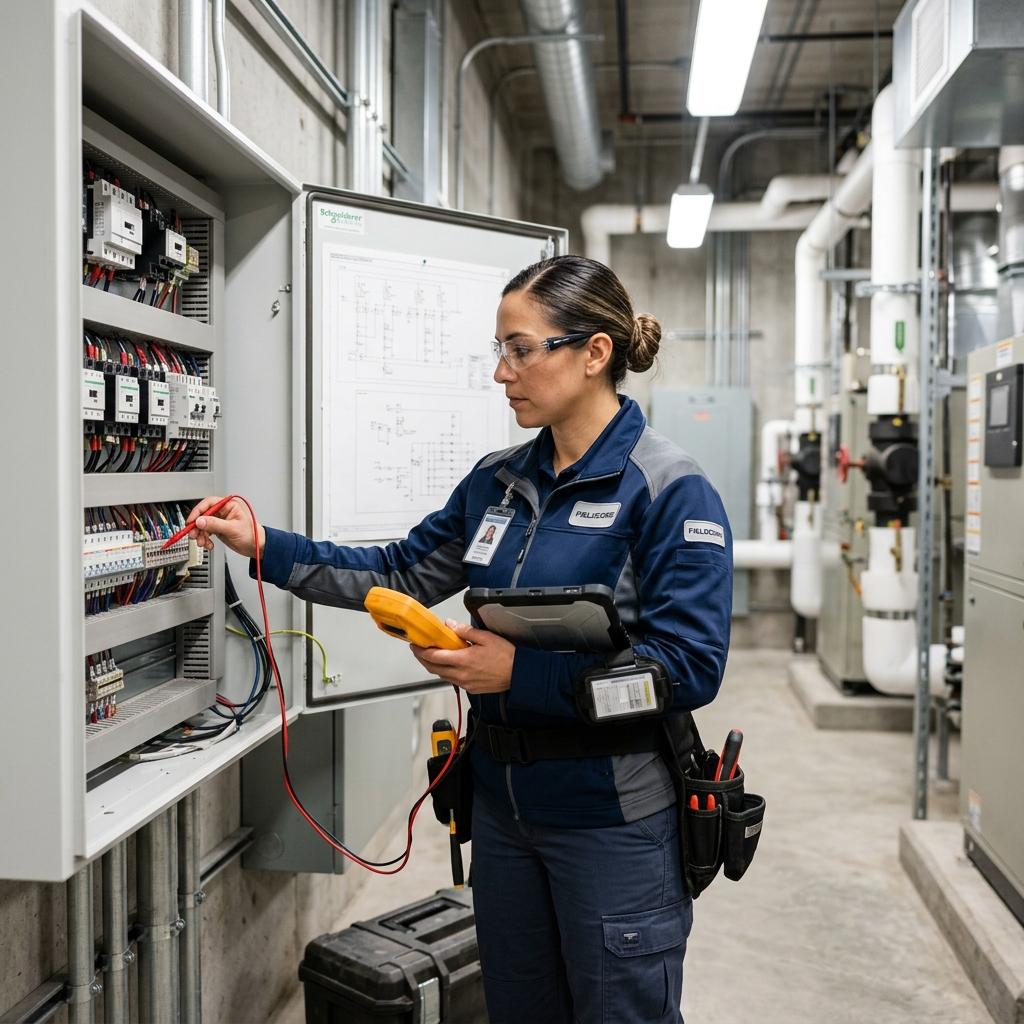
Field Service Inspection and Job Sheet Software for Mobile Technicians
IndeForms gives dispatchers a way to send the right form to the right technician for the right job, and gives technicians a way to complete it in one pass — pre-filled with customer and asset data, adapting as they answer, and signed by the customer before they leave. It works whether the job is in a plant room, a basement or a rural substation, because the app does not assume there is a network.
What paper and spreadsheets cost a service business
Field service runs on a job sheet, and the job sheet is usually a carbon-copy pad. The technician fills it in at the customer site, the customer signs it, one copy stays behind, and the top copy travels back to the office in a van, in a bag, sometimes for a week. Somebody in the office then keys it into the service system so the job can be invoiced. Asset serial numbers get transcribed twice. Parts consumed are written from memory. Meter readings are entered without any check that they are even plausible against the last reading.
The cost is concentrated at both ends of the process. At the front end, the technician arrives without the last visit’s findings, without the asset history, and without the specific checklist that this equipment model actually needs, so the first fifteen minutes of the job are spent reconstructing context. At the back end, revenue sits uninvoiced while paperwork travels, disputes over what was done are settled from a smudged carbon copy, and warranty claims fail because the commissioning record cannot be produced with the serial number attached.
Compliance-driven service work suffers most. A refrigerant leak check, an electrical safety test or a fire-system inspection is only worth what its record is worth. When the record is a pad, the certificate is retyped from it, and the underlying evidence — the readings, the photographs, the technician who actually performed the test — is not attached to anything.
The standards service records have to satisfy
Much field service work exists specifically because a regulation requires a periodic inspection. The record is the deliverable. These are the frameworks service organisations most often build IndeForms workflows around.
ISO 9001:2015
International Organization for Standardization
What it requires
Control of externally provided processes and service provision, documented information retained as evidence of conformity, and controlled records of monitoring and measurement activities.
How IndeForms supports it
Every job sheet is bound to the published form version it was captured against, carries the technician identity and the customer acknowledgement, and is retained with its full approval history rather than as a scan.
ISO 45001:2018
International Organization for Standardization
What it requires
Hazard identification before work begins, operational controls for high-risk activities, and documented incident reporting and investigation.
How IndeForms supports it
A point-of-work risk assessment can be made a mandatory precondition of the job form itself, so a technician cannot record work as started until the assessment is complete, and incidents route through their own approval workflow.
ISO 55001:2014
International Organization for Standardization
What it requires
Asset information requirements, documented condition and performance data, and evidence that maintenance activities were carried out as planned.
How IndeForms supports it
Job records are bound to an asset identifier captured by barcode rather than typed, so condition history accumulates against the asset and planned-versus-actual completion is measurable.
NFPA 25 and National Building Code of India 2016, Part 4
National Fire Protection Association; Bureau of Indian Standards
What it requires
Prescribed inspection, testing and maintenance frequencies for water-based and other fire protection systems, with records identifying the system, the activity performed, the results and the person performing it.
How IndeForms supports it
Frequency is driven by scheduled dispatch rather than by memory. Test results are validated numeric fields, deficiencies branch to a remediation workflow, and the completion certificate generates from the same record that holds the readings.
EU Regulation 517/2014 (F-Gas) and 40 CFR Part 82 Subpart F
European Commission; US Environmental Protection Agency
What it requires
Leak checks at intervals determined by charge size, records of refrigerant added and recovered, equipment and technician certification records, and retention of those records for the prescribed period.
How IndeForms supports it
Refrigerant added and recovered are captured as validated quantities per cylinder in a repeatable section, the leak-check interval is driven by scheduled dispatch, and the technician certification reference is carried on the record rather than assumed.
49 CFR 396.11 and the Central Motor Vehicles Rules, 1989
Federal Motor Carrier Safety Administration, United States; Ministry of Road Transport and Highways, India
What it requires
Driver vehicle inspection reports covering defects that would affect safe operation, with a record of the defect, the correction and the certification that it was corrected, alongside statutory fitness and documentation requirements.
How IndeForms supports it
Pre-trip and post-trip inspection forms dispatched to the driver each day, with defects branching to a workshop task, correction evidence required before closure, and the whole chain retained against the vehicle.
IndeForms provides the capture, scheduling, approval and retention controls behind these obligations. It does not itself certify equipment or personnel, and it does not replace an accredited certificate where one is required. Statutory sign-off stays with your certified technicians and competent persons.
How field services workflows run on IndeForms
Each of these is a real configuration of the platform — dispatch, offline capture, approval and reporting — not a roadmap item.
Dispatched service visit, from job sheet to invoice-ready record
The whole point of digitising the job sheet is to remove the van as a data transport mechanism. Getting there means the form has to be faster than the pad, not merely equivalent.
Dispatch
The job is dispatched to a named technician or broadcast to a group so the first available technician claims it. The form arrives pre-filled from the dispatch payload with customer, site, contract and asset details, and an API question can pull the live asset history from your service system as the technician opens the job.
Field capture
The technician scans the asset tag, works through the model-specific checklist that rules have selected out of a single master form, records readings against validated ranges, and photographs anything abnormal. Parts consumed go into a repeatable section with quantity and part number, and labour time is captured against the visit. None of it needs a network.
Customer acknowledgement
The customer reviews the summary and signs on the device. The signature is captured on the record itself, not on a separate sheet, and a PDF of the completed job sheet is emailed to the customer automatically on submission.
Approval and report
Jobs with a flagged reading, an out-of-scope finding or a quote requirement route to the service manager for review; routine jobs close straight through. Completed jobs push to the billing or service system through a connector, so the invoice does not wait on the van.
Outcome: The record is complete before the technician leaves the site, the customer already has their copy, and billing starts the same day rather than the following week.
Pre-installation site survey feeding a quotation
Surveys are the least standardised thing most service businesses do, and the most expensive to get wrong, because the quotation is built on them.
Dispatch
The survey is dispatched with the enquiry reference and customer details already populated, so the surveyor never re-keys context that sales already captured.
Field capture
Measurements, access constraints, existing equipment and utility positions are captured with photographs and annotated sketches. Rules branch the survey by installation type so a rooftop unit and a plant-room unit ask different questions. Calculation fields derive run lengths, duty and quantities inline, and an aggregation field totals the material take-off as the surveyor adds rows.
Approval
The survey routes to the estimator, who can send it back for a specific missing dimension without discarding the rest of the submission. A run-scoped variable carries the enquiry reference through every downstream step and notification.
Report
The take-off exports to the quotation process, and survey-to-quote turnaround, revisit rates and the most frequent missing-information reasons are reportable so the survey form can be improved with evidence.
Outcome: Quotations are built from a structured take-off rather than from a photograph of a notebook, and the number of return visits caused by a missing measurement is something you can actually track down.
Statutory periodic inspection with certificate generation
For inspection-driven service lines, the certificate is the product. The risk is a certificate that exists without the evidence behind it being retrievable.
Dispatch
Scheduled dispatch generates the due inspections from an asset and frequency list on a cron schedule, mapping spreadsheet columns onto form fields so each inspection arrives bound to its system, site and due date.
Field capture
Each test is a validated field with its acceptance range built in, so a failing result is visible immediately and the follow-up questions become mandatory automatically. Test instrument identity and calibration reference are captured on the record. A geo-control reading and per-field timestamps evidence that the test happened at the asset, at the time claimed.
Approval
The inspection routes to a qualified reviewer for technical acceptance with a server-verified e-signature. Failed items branch to a remediation job that stays linked to the original inspection.
Report
The certificate is produced as a PDF from the accepted record and delivered to the client, while the readings behind it stay queryable, so a challenge years later is answered from data rather than from a filing cabinet.
Outcome: Certificates and evidence are the same record, and overdue inspections are visible as a schedule gap rather than discovered during an audit.
Daily vehicle and equipment checks with defect escalation
Fleet and tool checks are the checks most likely to be signed without being done, because nothing happens when they are skipped and nothing happens when they are completed.
Dispatch
A pre-trip check is dispatched to every driver each morning on a schedule. A missing check is visible as an unsubmitted dispatch, which makes non-completion a measurable event rather than an invisible one.
Field capture
The driver works through the walk-around, with a photograph required for any item marked defective. Odometer entry is range-validated against the last reading so a transposed digit is caught on entry, and the check is location-stamped.
Escalation
A safety-critical defect branches immediately to the fleet controller and the workshop, with the vehicle flagged. A timer escalates any defect that ages past its target without a correction record.
Report
Completion rate by depot, recurring defects by vehicle and defect-to-repair time all report from the same data, and a scheduled report puts the open-defect list in front of the fleet manager each morning.
Outcome: The check becomes worth doing because a defect actually goes somewhere, and non-completion becomes visible on the day rather than after an incident.
Which capability solves which problem
The platform features behind the workflows above, mapped onto the constraints this industry actually works under.
Getting the right form to the right technician at the right time
Direct, broadcast, pull and scheduled dispatch
Assign to a named technician, broadcast to a pool where the first to accept claims the job, let technicians pull work themselves, or generate the day’s jobs from a spreadsheet on a cron schedule.
Plant rooms, basements and rural sites have no coverage
Offline-first mobile capture
Forms, reference data and rules live on the device. Full jobs including photographs, signatures and audio notes are completed offline and sync automatically on reconnection.
The technician arrives without the asset history
API question type pulling live data into the form
A question can call your service, CRM or asset system while the form is open and populate fields from the response, so context comes to the technician rather than the other way round.
Customer sign-off happens on a pad that then travels in a van
On-device signature and automatic PDF delivery
The customer signs on the record itself, and a completed job-sheet PDF is emailed to them on submission. Nothing waits on paper reaching the office.
Every equipment model needs a slightly different checklist
One master form, driven by rules
Conditional logic selects the questions, pages and sections that apply to the model, service type or contract, so you maintain one form instead of forty near-identical ones.
A defect gets recorded and then nothing happens to it
Workflow escalation and timers
Findings become tasks with owners and due dates. Timer nodes escalate ageing items automatically, and closure requires evidence and an approval rather than a verbal all-clear.
Use cases we support out of the box
Common forms and processes field services teams build first.
Site Surveys & Assessments
Pre-installation surveys with measurement capture, photo annotation, and auto-generated quote inputs.
Service & Maintenance Visits
Equipment-linked job sheets, parts consumed, customer signature, and time-on-site captured in a single flow.
Installation Verification
Commissioning checklists with photo evidence, serial-number capture, and warranty registration on submit.
Vehicle & Equipment Inspections
Pre-trip vehicle checks, tool register audits, and DOT-style compliance forms with defect escalation.
Customer Acknowledgements
On-site e-signatures with PDF receipts emailed to customers automatically on job completion.
We stopped waiting for paper to come back in a van. The job closes on site, the customer has their copy before we leave, and the invoice does not depend on anyone finding a carbon copy.
Service operations manager, building services contractor
Representative of conversations with teams in this sector, not a named customer reference.Field Services FAQs
The questions buyers in this industry ask before they shortlist a platform.
Can it read from and write to our existing service or CRM system?
Both directions are supported. An API question type can call your system while the form is open and populate fields from the response, so the technician sees live asset or customer data in the form. On completion, submissions can be pushed out as an API webhook, an SFTP file, an email PDF, or through a structured connector that maps individual fields into SAP S/4HANA or Dynamics 365.
How do jobs get assigned when we do not know in advance who is free?
Use broadcast dispatch. The job goes to a group of technicians, the first one to accept claims it, and the others are released automatically. You can also let technicians pull jobs themselves from a list of available work, assign directly to a named person, or generate the day’s jobs on a cron schedule from a spreadsheet of customers and field defaults.
Is the on-device customer signature enough for a service record?
A drawn signature is captured against the submission itself, with the technician identity, timestamp and, where enabled, location on the same record. Where an internal approval also needs to be signed, that step can require a password re-entry or a drawn signature verified on the server with a single-use token recorded against the workflow task. The two are separate: customer acknowledgement and internal technical sign-off.
We service dozens of equipment models. Do we need a form for each one?
No, and you should not build one for each. Use a single master form with rules that show, hide, require or clear questions, pages and whole sections based on the model, service type or contract selected at the start. That way there is one form to version-control and one place to make a change when a manufacturer updates a procedure.
Our technicians are not enthusiastic about new apps. What actually helps?
Three things in practice: the form must be pre-filled so the technician is not re-keying what the office already knows, it must hide every question that does not apply so a long master checklist renders short, and it must work with the phone in aeroplane mode. Voice input for free-text fields and on-device text extraction from photographs of serial-number plates also remove the two most disliked typing tasks.
Ready to close jobs on site instead of in the office?
Send us your current job sheet or inspection certificate. We will show you the dispatched, pre-filled, offline-capable version with customer signature, automatic PDF and a push into your billing system.